

Tupping Time: The Baffling Arithmetic of Sheep Breeding
Keeping track of Alfie, ewe dates, and the art of staying organised.

Introducing Alfie
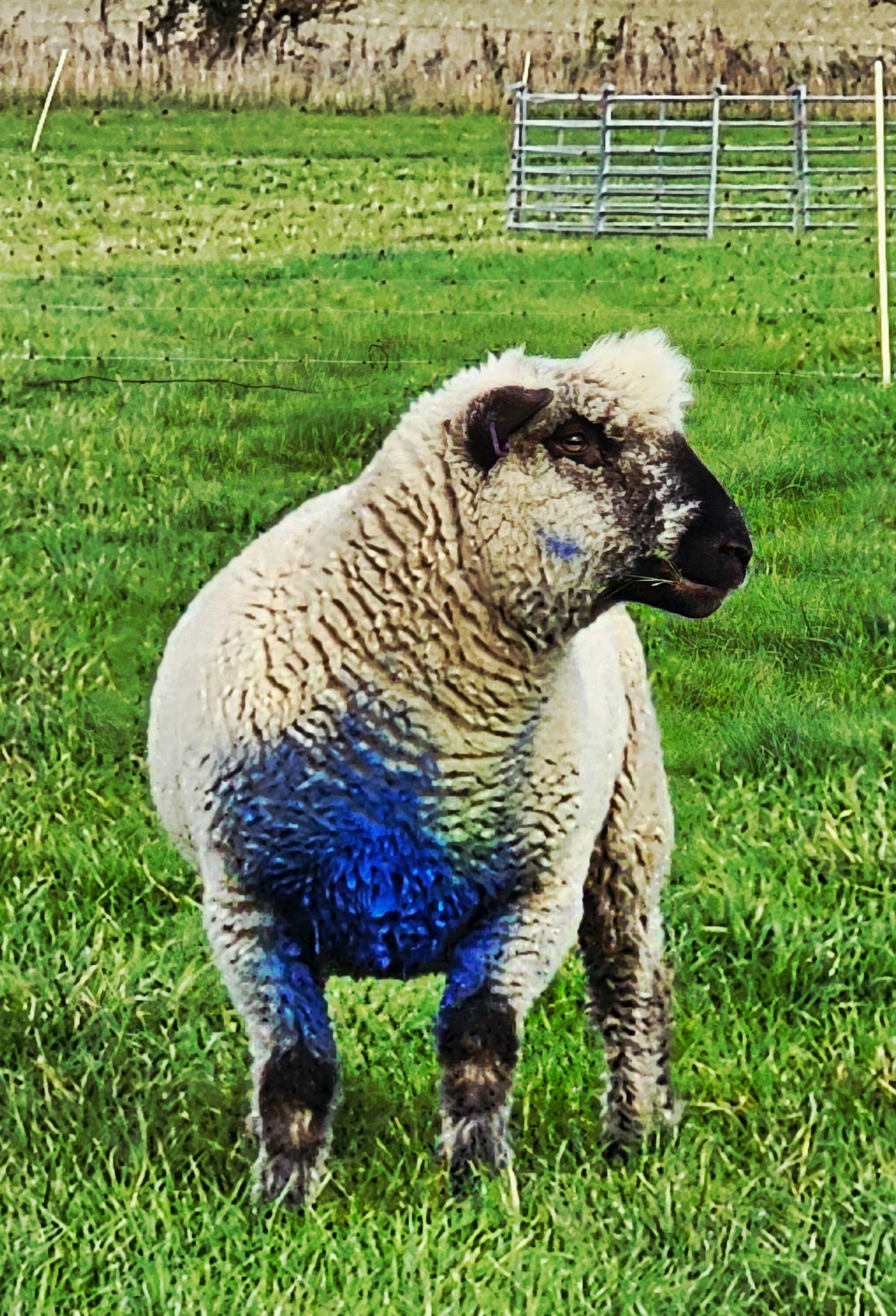
Back in September, we brought Alfie home and quarantined him for a couple of weeks. He’s a young’un, but sturdy. An Oxford Down shearling with the kind of confident swagger that suggests he’s already read his job description. Since then, we’ve been juggling like crazy, trying to implement a breeding plan which works on several different levels, within our very limited resources.
Finally the rain came, the temperature dropped, and bedraggled hens stood tetchily beneath the overhang of the nesting boxes - like wartime munitions girls, waiting for the bus home, their combs still bright, summer red, like Rosie the Riveter’s turban.
We try not to think too hard about the list of ‘things to be done before winter comes’ and its sparse ticks. The garden, the poultry and the goats all have a longish list of pre-season needs and wants (if we dwell on the goats’ wants we’ll be here all day) but first and foremost, we do need to concentrate on getting Alfie in with the right girls at the right times, with the crystal ball set to five months or so (I wish!)
Keeping Track
I have, in the past, been not the most prolific or efficient of record keepers. This has caused me endless grief, and that alone should be enough of a reason to ensure that these days, everything is carefully recorded as we go.
There are other reasons:
Our pedigree flock has a story. I can look anyone up on GrassRoots and discover her parentage, and her offspring, but it’s far nicer to be able to say ‘Ah yes, that’s Pixie’s great granddaughter.’ However, my memory is and always has been like the proverbial sieve, and we are not talking pastry flour here, we are talking garden soil, so records, of the written kind, are essential.
We sell breeding stock - we pretty much have to, with only ten acres and one small barn! And sometimes might sell a ewe in lamb - it’s important to know how far along she is and when she’s due.
This Year’s Master Plan
Once upon a time, we had a dream to show our pedigree sheep, and in 2019, that dream came true. Well. Sort of. Neil and Harriet showed at the Royal Bath and West (our local county show) and Harriet at Moreton Show, later in the season. I was at work at the time, and never got to set foot in the ring. I would still honestly love to show just once, and I’m not getting any younger!
Now, the key to having sheep to show is to lamb early. The rules are that the lambs should be born on or after January 1st of the year in question, but, as I explained here:
Those who plan on showing their lambs will (in theory) aim to have them born in January, which means August tupping. The idea is that you have the oldest lambs for the year of birth, so they are generally the biggest, so they generally win. The breed society allows a months grace, so that December born lambs count as next year’s flock. This is intended to allow a margin for error - so let’s say your lamb is born on December 30th, when you planned for January 1st, you’re ok.
In reality what happens is that these days, everyone sponges to get all the lambs born at the same, optimum time, and that time is the first week of December. In fact, at least one sheep showing person I know of usually unveils their first lambs on December 3rd with ‘oh look, sweet new-borns’ captions which everyone politely acknowledges, knowing full well those lambs are a week old.
Now we can’t do that, because we don’t have enough space for indoor lambing of more than a couple of ewes. Also, we wouldn’t want to. May the Lord preserve us from over zealous show people.
So, this year we decided to put Alfie in with three ewes at the very end of September, expecting February lambs, so still way behind the aforementioned zealots, but at least in with a chance - and then pop him in with the rest the first week in November. Bonfire Night (5th November) is the traditional time to put the tup (also known as a ram, I know, it’s confusing) in, which means you should start lambing on April Fools’ Day (1st April).
We chose three youngsters to be in the forward group. Two shearlings who have not yet lambed, and one, Gertie, daughter of the legendary Delilah, who will lamb for only the second time. In the aft group, there are two more shearlings, and two old girls, who may have decided to self retire, only time will tell.
So it’s going to be very important to keep track of who’s where.
In the UK all sheep are electronically ear tagged by law, so as long as you keep a record of which ear number is where, that’s a start, but for your own benefit, you need to keep more details for future use.
Raddle Rhythm
In order to know who’s been covered when, the tup is ‘raddled’, in one of two ways.
Either he wears a harness, fitted with a raddle ‘crayon’ made of wax, oil and pigment, or you dispense with the outfit, and just smear his brisket lavishly with a homemade goop comprising raddle powder, oil, and lard. We tend to do the latter.
Either way, when he mounts a ewe, she is marked on her back with the colour of the raddle. The ewes’ breeding cycle is from about 13 to about 19 days so, typically, after 17 days you change the colour.
If the ewe is pregnant, she won’t ‘return’ and get a second colour. If she isn’t, she will. It’s sensible to start with your palest colour and work upwards. Usually after two cycles, you take the ram out.
So this year, Alfie has gone in with our early lambers in green. All three were covered. We switched to blue, and none returned. Still raddled blue, he’s moved on to the main group - no blue bums yet, but hopefully there will be some before, at 17 days, we switch to red.
And Then We Wait
The gestation period of sheep is between 142 and 152 days so we always use 147 to calculate the due date.
That means we have one window of around 24th February to 4th March, and a second window (yet to be confirmed) which can’t start earlier than around 1st April.
The first three will need to be in the barn, out of the weather for at least a week or two. The second lot, with luck, will lamb happily outdoors with our open fronted lambing shelters to hand.
So Many Plans
It sounds simple, but actually, keeping your eye on the significant dates, even for two small groups, is only part of the challenge. Because, of course, I’m late planting my garlic, and that should have been on a plan somewhere, and in the UK we have just had the announcement of ‘Flockdown’ (whereby laying hens have to be housed because of increased risk of Avian Flu) and all of that needs recording.
The weather is unseasonably mild, the hens are still laying, and this time next year, I will wonder vaguely if we have more or less eggs than usual - that should be on a record somewhere!
The Homestead Binder Returns
Years ago, I kept what we called a Homestead Binder, which was basically a ring binder with sections for everything from lambing dates to garlic planting and egg production.
While I tinker away improving my skills on Notion (with dreams of creating an interactive version early next year — you’ll be the first to know!), I’m bringing back the old-school paper version for now.
The first printable, Sheep Breeding Records, will be available for paid subscribers next week. If you’d like to get your lambing notes in order (and stop wondering how many hens you had this time last year), it might just be the place to start.
Baffled No More
Maths was never my strong subject, and I do have to write things down. To this day, if seedlings are 10cm apart, and the bed is a meter wide, I have to draw dots on a grid to prove if it’s actually ten to a row.
Farming, if nothing else, teaches you patience and persistence. A day or two before my 66th birthday, as I officially become a pensioner, I decide to get my records sorted out! Make no apologies if you have also been meaning to do it for years! Let’s get unbaffled together.